For years, the conversation around residential solar was mostly about one thing: lowering your electric bill.
In 2026, that conversation is changing.
Homeowners are increasingly asking a bigger question:
What happens when the grid goes down, electricity prices spike, or my solar panels are producing power that I cannot use right now?
That is where home battery storage comes in.
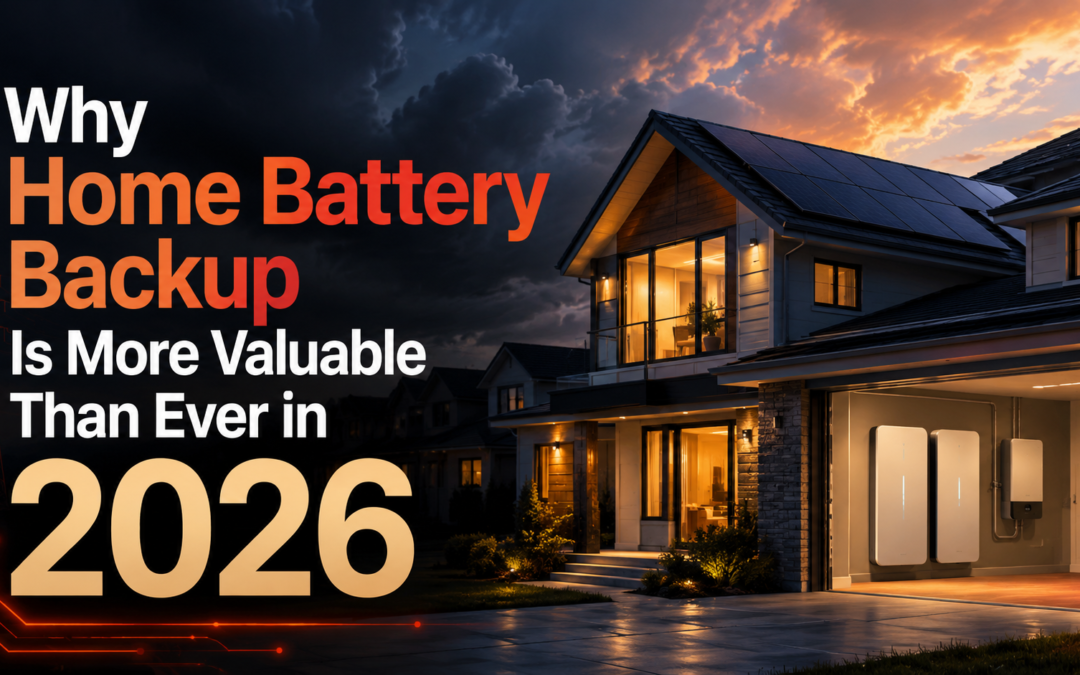
Modern battery systems such as the Tesla Powerwall 3 and FranklinWH aPower 2 give homeowners the ability to store electricity and use it when it provides the most value—at night, during periods of expensive grid electricity, or when the utility grid goes offline.
For homeowners considering solar in 2026, battery storage is quickly becoming one of the most important parts of the conversation.
Solar Panels Alone Don’t Necessarily Keep Your Home Running During an Outage
This surprises many homeowners.
You can have an entire roof covered in solar panels and still lose power when the grid goes down.
Most traditional grid-connected solar systems are required to shut down during an outage for safety reasons. The U.S. Department of Energy explains that residential solar systems generally need both the proper inverter configuration and energy storage to continue supplying power when the utility grid is unavailable.
That means solar produces your energy, but a battery gives you the ability to control when that energy is used.
With a properly designed solar-plus-storage system, your home can disconnect from the grid during an outage and continue powering selected circuits—or potentially much more of the home depending on the battery system, electrical loads, system design and number of batteries installed.
That distinction is becoming increasingly important.
Power Outages Aren’t Just an Inconvenience
Reliable electricity powers much more than televisions and lights.
Today’s homes can depend on electricity for:
- Refrigerators and freezers
- Internet and Wi-Fi
- Sump pumps
- Medical equipment
- Heating and cooling systems
- Well pumps
- Home offices
- Security systems
- EV charging
- Kitchen appliances
And recent reliability data shows why homeowners are paying more attention.
According to the U.S. Energy Information Administration, American electricity customers experienced an average of roughly 11 hours of power interruptions during 2024, nearly twice the average experienced during the preceding decade. Major weather events accounted for approximately 80% of those outage hours.
For Midwest homeowners, severe thunderstorms, high winds, ice, snow and extreme temperatures can all threaten grid reliability.
A home battery gives you another layer of protection between your family and those interruptions.
Instead of waiting for the utility to restore service, stored electricity can automatically begin supporting your home when the grid fails.
A Battery Lets You Use More of Your Own Solar Energy
During the middle of a sunny day, your solar system can sometimes produce more electricity than your home needs at that moment.
Without storage, excess energy generally flows back to the utility grid.
A battery changes that equation.
Instead of immediately exporting that electricity, your system can store a portion of it for later.
Then, when solar production falls in the evening, your home can begin drawing from the battery rather than immediately purchasing electricity from the utility.
Think of it this way:
Solar creates your electricity.
Battery storage saves it.
Your home decides when to use it.
That is a major step toward true energy independence.
The Department of Energy specifically identifies this ability to shift solar production from one part of the day to another as one of the primary advantages of solar-plus-storage systems.
Battery Storage Can Help Protect Against Expensive Electricity Hours
Electricity does not always have the same value throughout the day.
Some utilities offer hourly, time-of-use or demand-based electricity rates where electricity becomes more expensive during periods of high grid demand.
That creates another potential benefit for battery owners.
Instead of drawing heavily from the grid when electricity is expensive, a battery can potentially discharge stored energy during those periods and recharge when solar production is available or electricity is less expensive, depending on the utility program and system configuration.
Illinois homeowners can already see this price volatility in real-world electricity markets.
For example, ComEd’s Hourly Pricing program recorded real-time supply prices on July 1, 2026 ranging from only a few cents per kilowatt-hour during portions of the morning to 88.1 cents per kWh during the hour ending at 8 p.m.
Not every homeowner is enrolled in an hourly rate, and battery savings vary significantly by utility and rate plan. But the trend is important:
Why Battery Storage Still Matters After the Federal Residential Tax Credit
There is another major change homeowners need to understand in 2026.
The federal Residential Clean Energy Credit previously allowed qualifying homeowners to receive a 30% federal tax credit for eligible residential solar and battery-storage expenditures.
That changed after federal legislation accelerated the program’s expiration.
According to the IRS, the Residential Clean Energy Credit is not available for expenditures made after December 31, 2025.
That means the case for battery storage in 2026 is no longer simply:
“Buy a battery because there is a tax credit.”
Instead, homeowners should evaluate a battery based on what it actually does for their home:
Those benefits exist regardless of whether a federal residential tax credit does.
Tesla Powerwall 3: Serious Power in a Compact System
One of the best-known home energy storage systems available today is the Tesla Powerwall 3.
Powerwall 3 stores 13.5 kWh of energy per battery and can provide up to 11.5 kW of continuous AC output, depending on configuration.
That amount of power is important because battery storage isn’t only about how many kilowatt-hours a battery can hold.
Homeowners also need to consider how much power the battery can deliver at once.
Running lights and a refrigerator is one thing.
Starting an air conditioner, well pump or other high-demand appliance is another.
Tesla rates Powerwall 3 for substantial motor-start capability, making it a powerful option for homeowners looking beyond basic emergency circuits.
Powerwall 3 also integrates closely with solar and Tesla’s energy-management ecosystem, allowing homeowners to monitor solar production, battery charge and home energy usage through the Tesla app.
The system can also be expanded when additional storage capacity is required.
For homeowners who want a clean, integrated solar-and-storage solution, Powerwall 3 remains one of the strongest options on the market.
FranklinWH aPower 2: Whole-Home Flexibility and More Storage
Another increasingly popular option is the FranklinWH aPower 2.
A single aPower 2 offers 15 kWh of usable energy storage and up to 10 kW of continuous output.
FranklinWH also designed the system with demanding whole-home loads in mind. According to FranklinWH, aPower 2 has enough load-start capability to start equipment such as a five-ton air-conditioning system when properly configured.
One major advantage of the FranklinWH ecosystem is flexibility.
The aPower 2 is an AC-coupled battery, making it compatible with a wide range of existing solar inverter systems. Its aGate energy-management system can coordinate energy from solar, batteries, the utility grid and compatible generators.
The system can also scale significantly. FranklinWH allows as many as 15 aPower 2 batteries on one aGate, creating up to 225 kWh of storage capacity for applications requiring much larger amounts of backup energy.
FranklinWH backs the aPower 2 with a 15-year limited warranty, giving homeowners another compelling long-term battery option.
Tesla Powerwall 3 vs. FranklinWH aPower 2
There isn’t one battery that is automatically right for every home.
The better choice depends on how much electricity your home consumes, what you want backed up, your existing solar equipment and how long you want your stored energy to last.
| Feature | Tesla Powerwall 3 | FranklinWH aPower 2 |
|---|---|---|
| Battery Capacity | 13.5 kWh | 15 kWh |
| Continuous Output | Up to 11.5 kW | Up to 10 kW |
| Expandable | Yes | Yes |
| Whole-Home Backup Capable | Yes, when properly designed | Yes, when properly designed |
| Energy Monitoring | Tesla App | FranklinWH App |
| Warranty | 10 years | 15 years |
| Strong Fit | Integrated solar + battery systems | Flexible whole-home storage and retrofits |
A home with modest electrical loads may only need one battery.
A larger home with multiple HVAC systems, electric heating, a well pump, pool equipment or significant electrical consumption may benefit from two or more batteries.
That is why battery sizing matters just as much as battery brand.
One Battery or Two? Why Proper Battery Sizing Matters
When homeowners ask how long a battery will power their house, there is no single answer.
A 15 kWh battery does not automatically mean a specific number of hours of backup.
Runtime depends on what your home is consuming.
If your home is using 1 kW continuously, a battery theoretically lasts far longer than if the home is consuming 5, 8 or 10 kW.
This is why Tron Solar looks at the home’s actual electrical loads before recommending battery capacity.
Important questions include:
- Do you want essential-load backup or whole-home backup?
- Do you want to operate central air conditioning?
- Is the home heated electrically?
- Do you have a sump pump or well pump?
- Do you charge an EV at home?
- How much electricity does the home consume overnight?
- How long do you want to operate without the grid?
- Will solar be available to recharge the batteries during an extended outage?
For some homeowners, one Tesla Powerwall or FranklinWH aPower may provide the right balance.
For others, installing multiple batteries can dramatically change the home’s backup capabilities.
Solar + Batteries Can Be More Powerful Than a Traditional Generator
Generators still have their place, but battery storage offers several advantages.
A battery doesn’t require gasoline or propane deliveries. It doesn’t need to sit outside running an engine. And unlike a generator, a solar-plus-storage system can potentially recharge itself when sunlight returns during an extended grid outage.
The Department of Energy notes that solar paired with energy storage can provide continued power without relying on fuel deliveries, an important resilience advantage during prolonged disruptions.
Battery systems are also quiet and operate automatically.
When the grid goes down, there is no extension cord to pull out and no engine to start.
Your energy system simply reacts.
The Bigger Picture: Stop Thinking About Solar as Just Panels
The solar industry is entering a new phase.
The goal is no longer simply putting panels on a roof.
The goal is giving homeowners more control over where their electricity comes from, when they use it and what happens when the grid fails.
Solar panels produce electricity.
A Tesla Powerwall or FranklinWH aPower stores it.
Smart energy controls determine where that electricity goes.
Together, they create something far more valuable than a collection of individual products:
That is where residential energy is heading in 2026 and beyond.
Is a Home Battery Worth It in 2026?
For many homeowners, yes—but it depends on what you expect your battery to accomplish.
If you only look at a battery as another way to calculate a short-term financial payback, you are missing much of its value.
A home battery is also about resilience, predictability and control.
It means keeping important parts of your home running when the neighborhood goes dark.
It means storing electricity your solar panels already produced instead of immediately sending all of it somewhere else.
It means having greater control over when your home depends on the utility.
And for homeowners who already have solar, battery storage can be one of the most significant upgrades you can make to the system.
Take Control of Your Power With Tron Solar
Tron Solar offers advanced residential battery-storage solutions including Tesla Powerwall and FranklinWH systems, along with complete solar, electrical and home-energy solutions.
The right battery system starts with understanding your home—not simply choosing a battery off a spec sheet.
Our team can evaluate your electricity usage, solar production, major electrical loads and backup goals to determine whether one battery, multiple batteries or a complete solar-plus-storage system makes the most sense.
Because in 2026, energy independence isn’t just about producing electricity.
It’s about controlling it.
Ready to Add Battery Backup to Your Home?
Explore Tron Solar’s battery-storage solutions or speak with our team to find out whether Tesla Powerwall, FranklinWH aPower or another energy-storage option is right for your home.

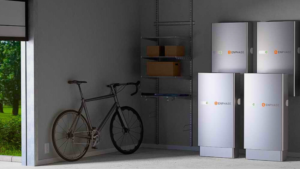 Our battery storage solutions are designed to provide reliable and efficient energy storage for your home or business. With our advanced battery storage systems, you can store excess energy generated by your solar panels or grid power and use it when you need it most.